
Heat Pumps & Grants: A Warmer, More Efficient Home
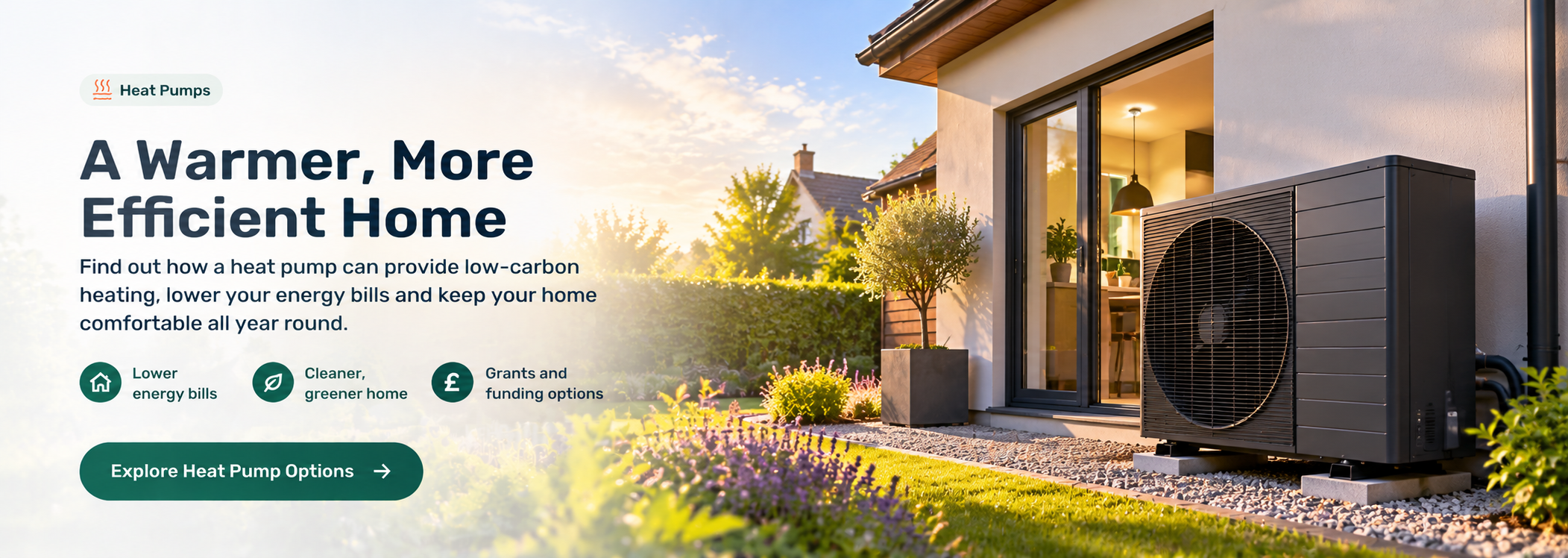
Independent UK homeowner guide · Funding and key guidance checked 31 October 2026. The illustration highlights potential benefits; actual running costs, savings and grant eligibility depend on your home and circumstances.
What Is a Heat Pump — and Why Consider One?
Think of a heat pump as a heating system that moves heat rather than creating it by burning fuel. It uses electricity to collect heat from the outside air or ground and bring it into your home. Even when it is cold outside, usable heat remains available.
1. Collect heat
An outside unit or underground pipes collect low-temperature heat from the surroundings.
2. Raise its temperature
An electrically driven refrigeration cycle makes that heat warm enough to use indoors.
3. Heat your home
Depending on the type, the system warms radiators, underfloor heating, a hot-water cylinder or indoor air.
Why consider one? A well-designed heat pump can provide efficient, lower-carbon heating and remove the need for a fossil-fuel boiler. Whether it cuts your bills depends on what you currently use, tariffs, the building and how the system performs.
Will it work in winter? Yes, correctly sized systems are designed to operate through cold weather. Heat pumps often work best heating steadily rather than rapidly bringing a cold home back up to temperature.
Which Type of Heat Pump Might Suit Your Home?
| Type | How it heats your home | Practical considerations |
|---|---|---|
| Air-to-water | Takes heat from outdoor air and heats water for radiators, underfloor heating and usually a hot-water cylinder. | Often an alternative to a boiler. Needs an outdoor unit, good system design and sometimes larger radiators. |
| Ground-source | Collects heat through pipes buried in the ground, then heats the home's water-based heating system. | Requires suitable outdoor land or a borehole, with more disruptive and often costlier installation. |
| Air-to-air | Warms indoor air through fan units, rather than heating radiators. | Can suit some flats or smaller homes; many also cool rooms, but hot water usually needs a separate solution. |
Is My Home Suitable?
Many existing homes can use heat pumps — not just new builds. Suitability depends on a proper assessment, not the age of the building alone. Ask for a room-by-room heat-loss calculation: it estimates how much heat your home loses on a cold day so the system can be sized correctly.
Insulation and draughts
Better insulation can reduce the amount of heat needed. Ask whether any improvements should be completed first.
Radiators and hot water
Some existing radiators can stay, others may need upgrading. An air-to-water system usually needs space for a hot-water cylinder.
Outdoor space and noise
An outdoor unit needs suitable airflow, drainage and positioning. Ask about neighbours, noise rules and service access.
Before asking for quotes, check:
- Which rooms are difficult to heat, and whether your home has major draughts or heat-loss problems.
- Whether there is space for an outdoor unit, pipe runs and a hot-water cylinder if needed.
- What radiators or underfloor heating are already fitted.
- Whether an installer has checked the electrical supply, location and planning rules.
- Whether the system will heat your whole home and meet your hot-water needs.
How Much Does a Heat Pump Cost to Install?
Energy Saving Trust indicates around £12,000 as a typical air-source heat-pump installation cost. Actual quotations can be significantly higher or lower. Ground-source installations often cost more, particularly where substantial digging or a borehole is needed. See Energy Saving Trust's cost guidance.
Make sure your quotation says whether it includes the outdoor unit, indoor equipment, hot-water cylinder, radiators, electrical work, pipework, controls, commissioning, and any making good or extra groundworks.
Illustrative England or Wales example — eligible air-to-water installation
Example only, not a quotation or confirmation of eligibility. The installer must establish grant eligibility, and grant funds must be reflected on the quotation and invoice. The same figures do not apply to every heat-pump type or UK nation.
Other costs to budget for: radiator upgrades, hot-water cylinder space, insulation, electrical upgrades, preparation of the outdoor site, possible excavation and repair work after installation. Ask for these costs upfront, not after work begins.
Will My Heating Bills Be Lower?
Not automatically. A heat pump can be very efficient, but electricity often costs more per unit than mains gas. The key is how many units of heat your system provides for each unit of electricity it uses, plus the tariff and heating needs of your home.
A simple example of running costs
Suppose a home needs 12,000 kWh of useful heat per year. Using purely illustrative tariffs and efficiencies:
| Heating system | Assumptions | Illustrative yearly heating energy cost |
|---|---|---|
| Gas boiler | 90% efficiency; gas at 7p/kWh | About £933 |
| Heat pump | Seasonal efficiency 3.2; electricity at 24p/kWh | About £900 |
Calculations: gas = 12,000 ÷ 0.90 × £0.07; heat pump = 12,000 ÷ 3.2 × £0.24. This compares heating energy only, not standing charges, maintenance, other electricity use or differences in hot-water demand. It is a worked example, not a current energy price quote or savings forecast.
What should you ask an installer? Request their estimate of annual electricity consumption, expected seasonal performance, the assumptions behind those figures, and how your costs compare with your actual current energy bills.
Heat Pump Grants: What Financial Help Could I Get?
Grant arrangements differ across the UK. A grant helps pay an eligible cost and is not normally repaid. A loan must be repaid, even if interest-free. Never assume a grant has been approved until the provider confirms eligibility.
England and Wales — Boiler Upgrade Scheme (BUS)
| Qualifying system or situation | Grant amount |
|---|---|
| Air-to-water heat pump | £7,500 |
| Ground-source heat pump (including eligible water-source systems) | £7,500 |
| Qualifying air-to-air heat pump | £2,500 |
| Eligible off-gas-grid home replacing oil or LPG heating with qualifying air-to-water or ground-source system | Up to £9,000, with uplift scheduled to apply until 31 March 2027 |
Eligibility depends on the property, existing heating, the technology selected and other scheme rules. Property owners may include landlords, but not every home or installation qualifies. A Microgeneration Certification Scheme (MCS) certified installer normally applies to Ofgem on your behalf, and the confirmed grant should be deducted from your installation cost.
Next step: Get comparable quotes from eligible installers, confirm the grant shown on each quote and wait for the required consent and eligibility checks. Government BUS guidance · Ofgem property-owner guidance.
Scotland — Home Energy Scotland Grant and Loan
Eligible homeowners living in their main home may be able to receive up to £7,500 as a heat-pump grant, plus an optional interest-free loan of up to £7,500. A £1,500 rural/island grant uplift may apply. The scheme has its own requirements and is not the England-and-Wales Boiler Upgrade Scheme.
Important: Do not assume an air-to-air or hybrid system qualifies under the Scottish heat-pump grant, and do not start work before receiving required funding approval. Check Home Energy Scotland's current guidance.
Northern Ireland — Check Available Local Support
There is currently no general dedicated heat-pump grant equivalent to the Boiler Upgrade Scheme. Limited support may be available through local programmes, including some Northern Ireland Sustainable Energy Programme measures, depending on household and project eligibility. Check current options before assuming any funding. Energy Saving Trust: Northern Ireland guidance.
What about VAT?
Qualifying supplied-and-installed heat pumps in UK residential accommodation may benefit from 0% VAT until 31 March 2027, with the rate scheduled to be 5% from 1 April 2027 under current rules. Ask your installer to explain how VAT is shown on the quote. This is tax relief, not an additional cash grant. HMRC VAT guidance.
Grant amounts and eligibility checked 31 October 2026. Schemes may change, pause or run out of allocated funds; official conditions at application time take precedence.
From First Enquiry to a Working Heat Pump
- Check your home. Note how warm each room gets, existing heating equipment and likely insulation issues.
- Understand funding first. Check the rules for your UK nation before signing or starting work.
- Get a heat-loss survey. Ask for room-by-room heat demand and realistic sizing calculations.
- Compare quotes. Request at least two detailed quotes using similar assumptions and grant treatment.
- Check permissions and placement. Confirm planning, noise, neighbour considerations and electrical requirements.
- Commission and learn controls. Obtain installer handover, warranty details and clear guidance on using the system efficiently.
Do you need planning permission?
Some heat-pump installations are permitted development (meaning a separate planning application may not be necessary), but conditions depend on the location, equipment, noise and property. Listed buildings and protected areas may need additional consent. Rules differ across England, Wales, Scotland and Northern Ireland. Ask your local planning authority and installer to confirm before installation.
What should a proper quote include?
- Make and model of equipment, heat-output rating and room-by-room heat-loss assumptions.
- Predicted seasonal efficiency and estimated annual electricity consumption.
- Radiators, controls, cylinder, electrical work, insulation assumptions, and all extra charges.
- Clear grant deduction, VAT treatment and expected amount you pay.
- Installer credentials, product and workmanship warranties, maintenance and aftercare.
Common Questions Homeowners Ask
Will the heat pump keep my home warm on freezing days?
A correctly sized and installed system should be designed for winter conditions. The heat-loss survey and system sizing are critical.
Will I need to replace all my radiators?
Not necessarily. Some radiators may already be large enough; others might need changing. Request a room-by-room radiator assessment.
Do I need a hot-water tank?
Most air-to-water systems provide hot water through a cylinder. Air-to-air systems generally need a separate hot-water solution.
Are heat pumps noisy?
Outdoor units make some sound, but noise varies by product, operating conditions and placement. Ask about the manufacturer's sound data and planning noise requirements.
Do heat pumps cool a home in summer?
Some air-to-air systems offer active cooling. Many UK air-to-water installations do not provide practical summer air conditioning; confirm the exact system's capabilities.
How long does installation take?
It varies with the system and house. Replacing a boiler may involve several days of work, while groundworks or extensive radiator changes can take longer. Ask for a written schedule and disruption plan.
Can landlords apply for a grant?
Some landlords can qualify for England and Wales BUS grants if property and system conditions are met. Scottish Home Energy Scotland homeowner grants generally require the applicant to live in the property as their main home. Check the specific scheme.
Do heat pumps need maintenance?
Yes. Follow the manufacturer's service and cleaning instructions, keep the outdoor unit's airflow clear, and ask about ongoing service costs and warranty requirements.
How do I know if the quoted running costs are realistic?
Ask what annual heat demand, tariff, seasonal efficiency and hot-water demand were assumed, then compare those assumptions with your current bills.
What Should I Do Next?
- Read the relevant country-specific funding rules.
- Arrange a property assessment and suitable heat-loss survey.
- Compare itemised quotations and realistic running-cost estimates before deciding.